
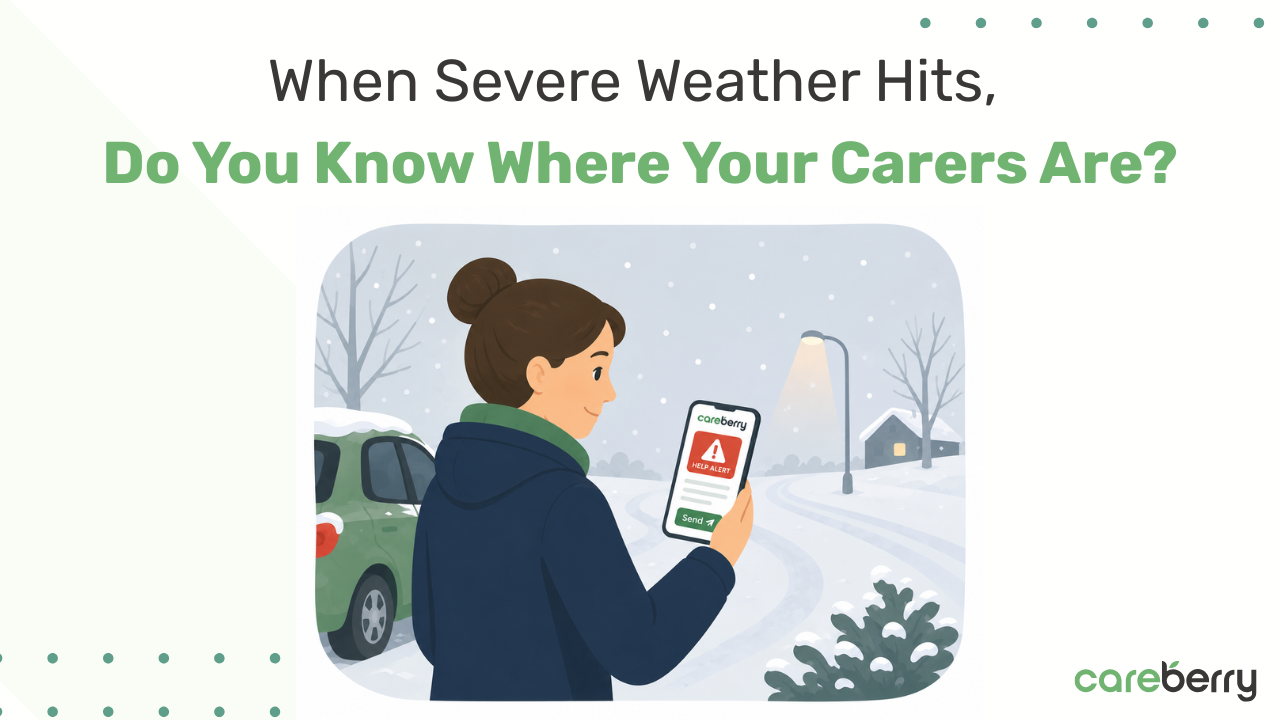
When Severe Weather Hits, Do You Know Where Your Carers Are?
Years ago, when I set up my first care company and the team was still small, I developed a habit that was hard to break. On nights with bad weather, I would stay awake until my last carer had safely returned home. I didn’t do it because anyone asked me to; I couldn’t rest until I knew they were safe.
If you’ve ever run a home care service, you’ll understand the concern. Picture a dark, cold winter night, ice on the roads, and a carer driving alone through the rural villages of Buckinghamshire or Oxfordshire to reach one more client. There are stretches of road without streetlights and with weak cell signals. I’ve driven out myself to assist a caregiver whose car had broken down in the freezing cold, sitting with them until help arrived. During those drives home, I kept thinking: there has to be a better way to ensure my team’s safety.
That worry never truly left me, and it’s one of the reasons we built what we built.
Weather Is Crueller to the People We Care For
Severe weather isn’t a backdrop to care. For older and vulnerable people, it can be the event itself.
A cold snap can lead to falls on icy paths, hypothermia in under-heated homes, and the difficult choice between heating and eating. A heatwave, on the other hand, brings dehydration and confusion, affecting those who struggle to cool themselves down or call for help. Storms and floods can isolate housebound individuals from essential visits that check on their well-being.
These situations are not just abstract concepts. When weather conditions change, the risk to those relying on assistance quietly increases and often goes unnoticed until someone arrives to investigate and discovers a problem.
The Hidden Risk: A Workforce on the Road
Home care is inherently a mobile profession. Unlike care homes where teams operate under one roof, domiciliary carers travel between clients, often in their own vehicles, typically working alone and frequently in areas with poor mobile signal. For many home care roles, having a driving licence and a vehicle is not just advantageous; it is a requirement of the job.
When dangerous weather conditions arise, your service faces challenges on two fronts: the increased risk to clients and the danger posed to a workforce that is out in the elements all day. Both situations require a comprehensive plan.
People first. Process next. Technology always.
Order is crucial in this situation, perhaps more than in any other. No app can ensure a carer is safe on an ice-covered path. However, technology can help by shortening the time between an incident occurring and someone being alerted. It ensures that the right people are notified before they embark on their journey, rather than after an incident has already happened.
Communication That Counts as Evidence
When a storm or cold-weather alert is imminent, a Registered Manager must act quickly to do two things: notify the individuals receiving care and their families, as well as inform the team providing care to them. The challenge is that using scattered texts and WhatsApp messages leaves no clear record. If an inspector later inquires about how you ensured the safety of individuals during a severe weather event, simply saying, "I think I messaged everyone" is not a sufficient response.
This is where Careberry comes in. It allows you to send communications to clients, their families, and staff, tagging them as weather alerts. This ensures that the information reaches the appropriate individuals and is documented in your audit trail. You can provide clear evidence afterwards of who was warned, what the warning entailed, and when it was communicated. This not only demonstrates good practice on the day of the alert but also serves as valuable evidence during inspections.
A Help Alert for the Carer Who’s Stuck
Warning people is just the first part of the equation. The second part focuses on what occurs when a carer finds themselves in trouble, whether they're broken down, stranded, or simply unsure of their location on an unlit road.
To address this, we developed a help alert feature within Careberry. With this tool, a carer can quickly send their location and a simple help message to the office with just a couple of taps. This eliminates the need to fumble to describe an unfamiliar junction and removes any guesswork about where to send assistance.
I often lie awake worrying about not knowing where my last carer was, and this feature directly addresses that concern. While it may seem like a small addition in the context of the entire platform, it can make all the difference on a challenging night.
Plan for the Storm Before It Arrives
Severe weather is one of the few risks in care that you can often anticipate. The forecast provides you with hours, sometimes days, of warning. A resilient service utilises that time effectively:
- Review which clients are most vulnerable to cold, heat or isolation, and prioritise them.
- Decide in advance which visits can be rescheduled, doubled up, or covered by the nearest carer.
- Send a tagged weather alert to families and staff early, so nobody is surprised.
- Make sure every carer knows how to raise a help alert before they’re out in the dark needing it.
- Keep the audit trail clean, so the care you took is visible afterwards.
None of this replaces judgement, kindness, or the manager who will still drive out at midnight when it matters. It simply means that judgment is backed by a system, rather than relying on memory and luck.
Want to see how Careberry helps you keep your team and your clients safe when the weather turns? Book a demo today.


Join Our Newsletter for Updates, Tips and Insights.